
Forward deployed engineer interviews that test the code and the customer
A forward deployed engineer, or FDE, writes code and scopes problems with the customer in the same week. Codility tests both halves in three real-world tasks: scope the customer’s request, build with Claude Code or Codex, then write the reply to the customer.
AI tools included, no API keys needed Validated assessments since 2009 SOC 2 Type II ISO 27001
Trusted by teams at
































Most FDE interview processes test only half of the job
01
A coding test shows how someone writes code. A case study shows how they structure a business problem. Neither shows whether the same person can do both with a real customer in the same week.
02
Every company builds its own interview process from take-homes, customer role-plays, case studies and interviews where the candidate breaks a vague problem into a plan. Few are scored the same way from one interviewer to the next.
03
FDEs ship with coding agents, so a take-home without AI tests a job that no longer exists. With AI allowed, the finished code shows little about how the candidate directed the agent.
An FDE’s job runs before, during and after the code
In open FDE job postings, 92% describe building and shipping production software. 78% describe scoping problems with the customer, and 66% make customer-facing experience a hard requirement. The usual tests each see only part of that.
Share of open FDE job postings that describe each part of the work. Source: Codility analysis of 3,960 open forward deployed engineer job postings, November 2026. Requirement shares come from the 2,723 postings that list structured requirements.
One assessment that follows the job: plan, build, communicate
Plan: scope the customer’s request
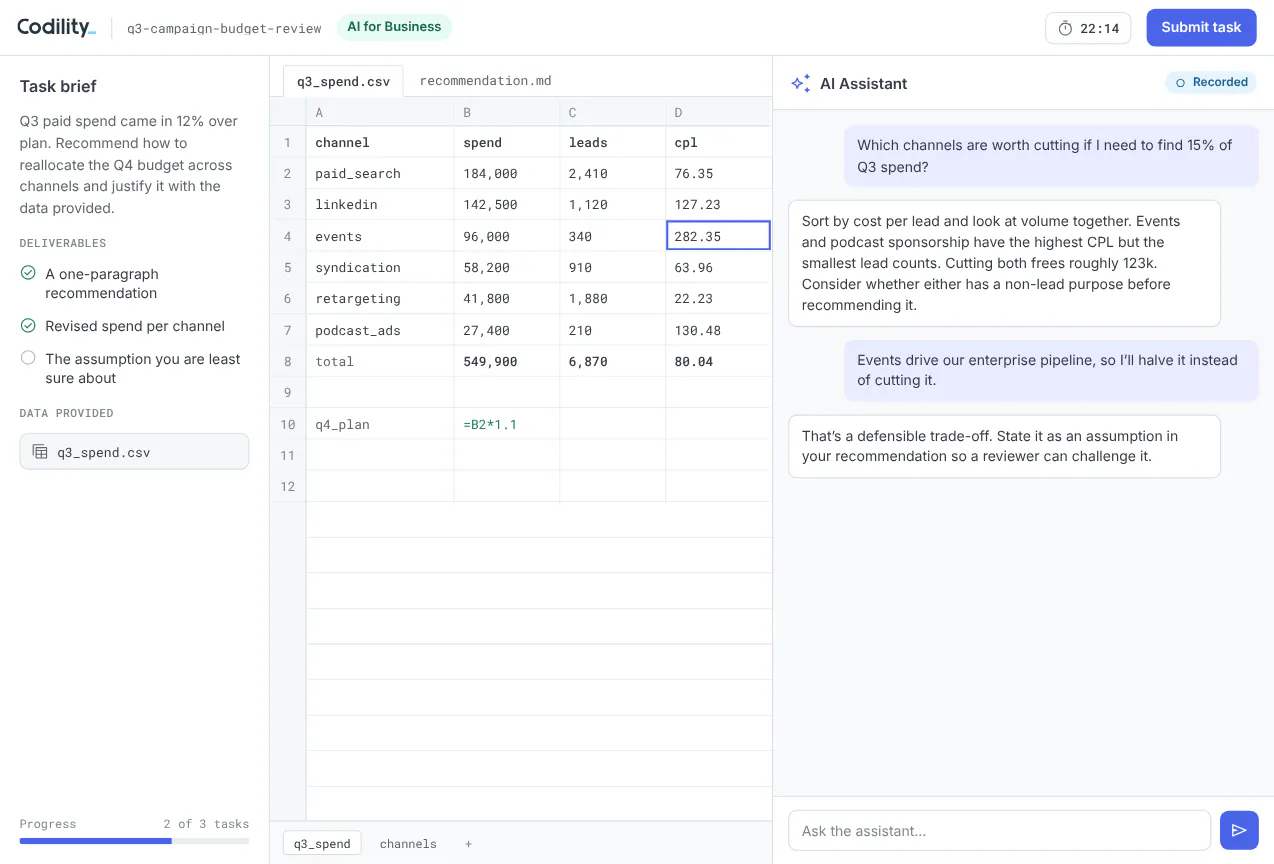
The candidate starts from an incomplete brief and questions simulated stakeholders, such as a CTO, a business owner and procurement, to find out what the customer needs. Each stakeholder holds facts that are missing from the brief, and the score reflects how much of that information the candidate draws out.
Build: write the code with Claude Code or Codex
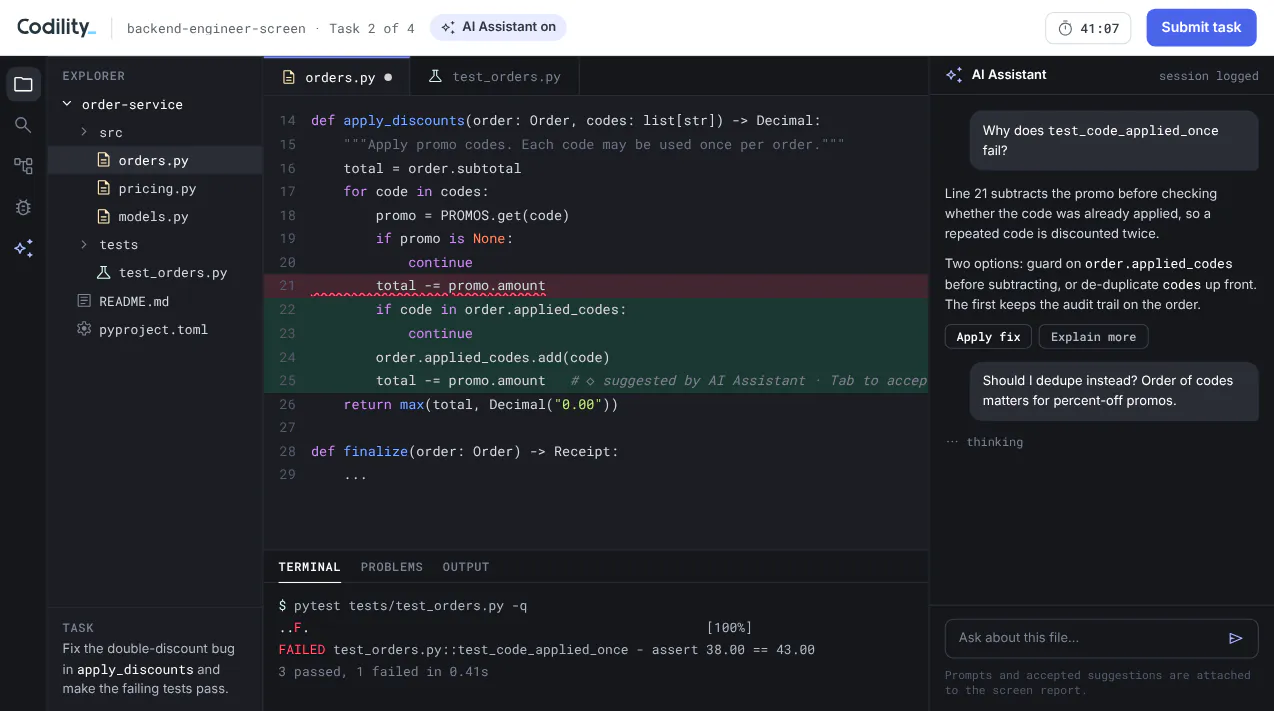
The candidate builds a system in Python that sorts incoming customer emails and routes each one to the right workflow. They use the real Claude Code or Codex when you allow it, with AI usage included and no API keys to set up. Hidden tests score the result.
Communicate: write the reply to the customer
The candidate reads a new request from the customer and decides whether it refines the agreed scope or expands it. Then they write the reply: what changes, what it costs in scope, speed and quality, and what the customer has to decide.

See both halves of the job in one report
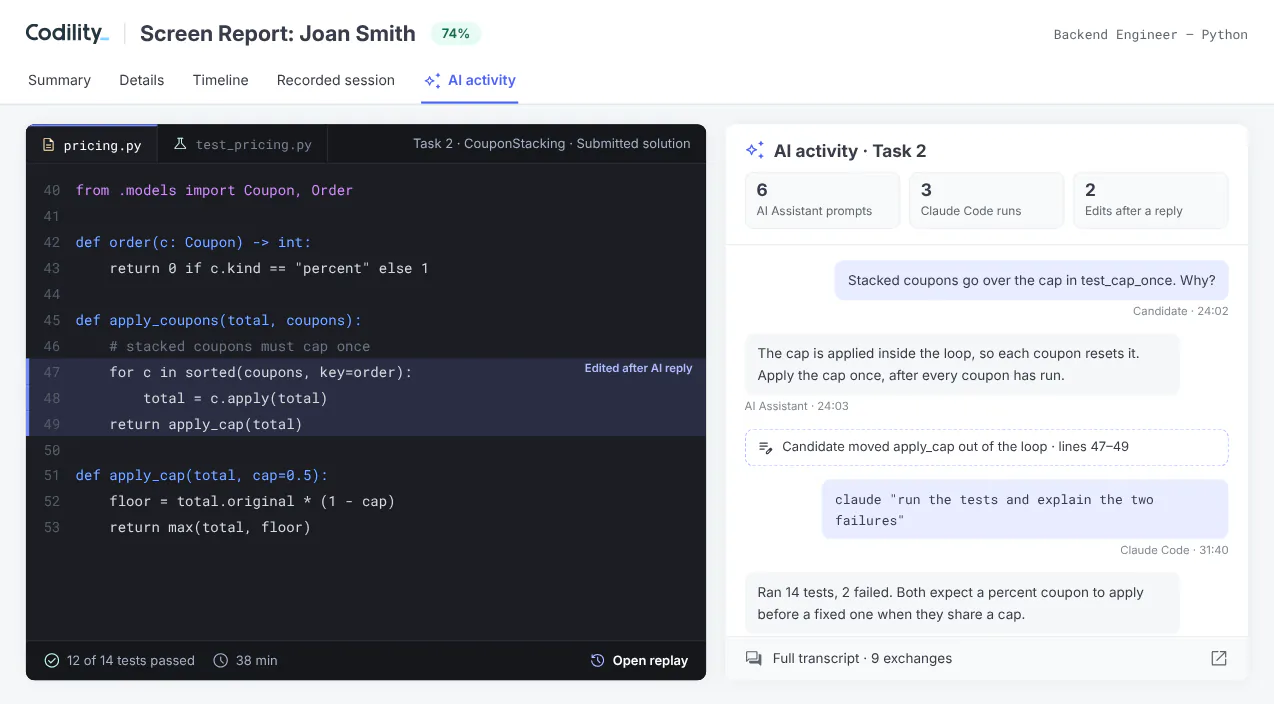
Each task gets its own score, so a strong coder who skipped the scoping stands out. A full assessment takes 60 to 90 minutes for one role, and every candidate gets the same tasks and the same scoring rules. Codility gives your hiring team the evidence, and your team makes the final decision.
- A separate score for Plan, Build and Communicate
- Every prompt to Claude Code or Codex, saved to the report
- Who directs the agent and who accepts its first answer
From the first screen to the engineers you already have
Screen runs the three tasks at volume before the interview, and every AI interaction is saved as reviewable AI activity.
Interview takes the final round live in a shared VS Code environment with Claude Code and Codex, a whiteboard and a full transcript. When the role needs it, add a business task to see how the candidate works with AI outside the code. Your interviewer runs the customer conversation and judges it.
Skills Intelligence runs the same assessment across your current engineers, so you can see who is ready to move into an FDE role and what each one still needs to learn.
Built on almost two decades of assessment science
Every FDE you hire sits in front of a customer.
Make decisions you can explain and defend.
Candidate figures: Codility candidate feedback survey, October 2025 to April 2026, across Codility assessments. 46,863 responses for the 87% figure and 45,925 for the 91% figure.
Bring your FDE job description
The assessment is ready-made, then tuned to your role. Companies define the FDE role differently, so the assessment science team sets it up with you in four steps.
Share the role
Send the job description, and tell us what separates a strong FDE at your company from an average one.
See what each task measures
The assessment science team maps your role to Codility’s skills and shows you how each task is scored.
Choose Screen, Interview or both
Screen runs the assessment at volume before the interview. Interview takes the final round live.
Calibrate with your own engineers
Your hiring managers and best FDEs take the tasks first, so the passing score reflects people who succeed in the role.
What happens next
- Tell us about the role in the form.
- A specialist shows you the three tasks, how each one is scored and how candidates work with Claude Code and Codex.
- The assessment science team tunes the tasks to your job description, ready in as little as a week.