
Article AI and Hiring
What will hiring look like in 2027? 6 shifts the research points to

In short
In 2027, hiring teams will need evidence that candidates can do good work with AI. Gartner predicts that by 2027, 75% of hiring processes will include certifications and testing for workplace AI proficiency. Research published in 2026 points to 6 shifts. Employers test for AI skills. Checking AI’s work becomes the key skill. Teams test with AI on and with it off. Each hire matters more. Every department needs AI skills. And a human in the loop – instead of AI – needs to own every hiring decision.
Key takeaways
- Only 17% of developers use no AI tools at work, in Stack Overflow’s 2026 Developer Survey. The open question is how well the rest use them.
- Gartner predicts that by 2027, 75% of hiring processes will include certifications and testing for workplace AI proficiency.
- In Microsoft’s 2026 Work Trend Index of 20,000 people who use AI at work, the top answer for the most important human skill was checking the quality of AI’s output, chosen by 50%.
- In a 2026 Anthropic randomized trial, developers who learned a new coding library with AI scored 50% on a follow-up quiz, against 67% for those who coded by hand. Some skills need testing with AI switched off.
- 40% of US hiring managers have interviewed a candidate later found to be using a fake identity, up from 31% in 2025, in a Checkr survey of 3,000 managers from September 2026.
- 72% of people say AI has changed the skills expected of them, and only 36% feel adequately trained, in BCG’s 2026 survey of close to 12,000 people.
- The EU AI Act’s strictest rules, for systems it calls high-risk, apply to AI used in hiring from December 2, 2027.
- Codility tests AI skills on work from the job. Teams allow or turn off AI for each task or interview, every AI interaction is saved for review, and no AI model scores a candidate.
Why is 2027 the year hiring has to answer the AI question?
The tools spread faster than any way of checking who uses them well. Stack Overflow’s 2026 Developer Survey, published in October 2026, asked more than 17,000 developers whether they use AI tools at work. Only 17% said no, and 66% use AI coding assistants or coding agents. In engineering, more than 4 in 5 developers already use AI at work.
The way companies check for the skill has not kept up. In October 2025, Gartner predicted that by 2027, 75% of hiring processes will include certifications and testing for workplace AI proficiency, and expected many organizations to bring in practical AI proficiency assessments within 2 years. It remains Gartner’s latest forecast on hiring for AI skills.
I went through the research on AI and work published in 2026 to see what will shape hiring in 2027. The same 6 shifts came up again and again. Each one is a problem talent and engineering teams will have to solve.
| Shift | What the research found |
|---|---|
| Employers test for AI skills | By 2027, 75% of hiring processes will include certifications and testing for workplace AI proficiency. Gartner prediction, October 2025. |
| Checking AI’s work becomes the key skill | Checking the quality of AI’s output was the top answer for the most important human skill, chosen by 50% of people who use AI at work. Microsoft Work Trend Index, May 2026, 20,000 workers. |
| Teams test with AI on and with it off | Developers who learned a new coding library with AI scored 50% on a follow-up quiz, against 67% for those who coded by hand. Anthropic randomized trial, January 2026, 52 developers. |
| Each hire matters more | 22% of heads of HR say a business leader in their organization has stopped hiring for entry-level roles because of AI automation. Gartner, July 2026, 110 heads of HR. |
| Every department needs AI skills | 72% of people say AI has changed the skills expected of them, and 36% feel adequately trained. BCG, June 2026, close to 12,000 employees, managers and leaders. |
| A person owns every hiring decision | 24% of leadership teams agree on who should be accountable for AI agents. Gartner, October 2026, 297 heads of HR. |
Will candidates have to prove their AI skills in 2027?
Yes, and increasingly on work from the job itself. Gartner ties its 75% prediction to pay: as AI skills earn higher salaries, candidates have more reason to learn them and prove them. PwC’s 2026 Global AI Jobs Barometer analyzed more than 1 billion job ads. It found that workers with AI skills earn 62% more on average than comparable workers without them, up from 57% a year earlier. Lightcast found that the share of US job postings mentioning AI skills rose 60% in the first half of 2026 compared with 2025.
When a skill carries that kind of premium, every resume claims it. I covered why resumes, interviews and self-ratings miss this skill in how to assess AI skills in candidates. The short version: a claim costs nothing to write.
Employers have started writing AI skills into their hiring requirements. Zapier has required every new hire to meet a minimum standard for using AI since 2025. In March 2026 it raised that standard, and its skills tests now observe “candidates working with AI in real time.” Inside companies, the same expectation is reaching performance reviews: in Stack Overflow’s 2026 survey, 10% of developers said their organization measures AI use as part of employee or team performance.
So the test has to look like the work. The candidate gets a task from the job, the files behind it and the AI tools the job uses, and the hiring team sees what they did with them. In Codility Screen and Interview, engineering candidates can work in a real VS Code environment. A task can include our AI Copilot and the coding agents Claude Code and Codex, ready to use in the terminal with no separate account or API key needed. For business roles, AI for Business works the same way inside Screen and Interview, with an AI Assistant beside a realistic task such as checking a budget report before a manager acts on it. Every prompt and answer is saved for the hiring team to review.
What skill matters most when everyone uses AI?
The skill that matters most is judging what the AI produces: catching what is wrong, checking what looks right and deciding what to ship. Microsoft’s 2026 Work Trend Index surveyed 20,000 knowledge workers who use AI, across 10 countries. Asked for the most important human skill, 50% chose checking the quality of AI’s output, and 46% chose critical thinking. 86% said they treat its output as a starting point and stay responsible for the thinking.
Developers say the same thing in their own words. In Stack Overflow’s 2026 survey, the most common answer about trusting AI, chosen by 48%, was “I trust it when I can easily verify the output.” Only 6.6% trust it with important work decisions.
Gartner has told heads of HR to update their recruiting processes to “prioritize AI judgement and critical thinking.” That changes what a good test has to record. A task that only checks the final answer can’t separate a candidate who checked the AI’s work from one who got lucky. The evidence is in how they worked.
Some of our tasks are built so you can see a candidate’s judgment. In some of them, the assistant makes mistakes, some planted on purpose, and the candidate has to catch them, check the rest and hand in a result they would stand behind. The reviewer sees the full AI conversation next to the result. In Codility Interview, the hiring team watches the candidate work with AI live in a shared VS Code environment, and can ask why they accepted one suggestion and threw out another.
Should you test candidates with AI or without it?
Both, depending on the skill. The clearest 2026 evidence for switching AI off comes from a randomized trial Anthropic published in January 2026. In the trial, 52 developers, most of them junior, learned a Python library they had not used before. Half had an AI assistant and half coded by hand. On a quiz straight afterward, the AI group averaged 50% and the hand-coding group 67%, with the widest gap on debugging questions. The AI group finished about 2 minutes faster, a difference too small to be statistically significant.
How they used the assistant mattered as much as whether they had one. Developers who used it to explain code and concepts averaged 65% or more on the quiz. Those who handed it the work, or leaned on it to fix their bugs, averaged under 40%.
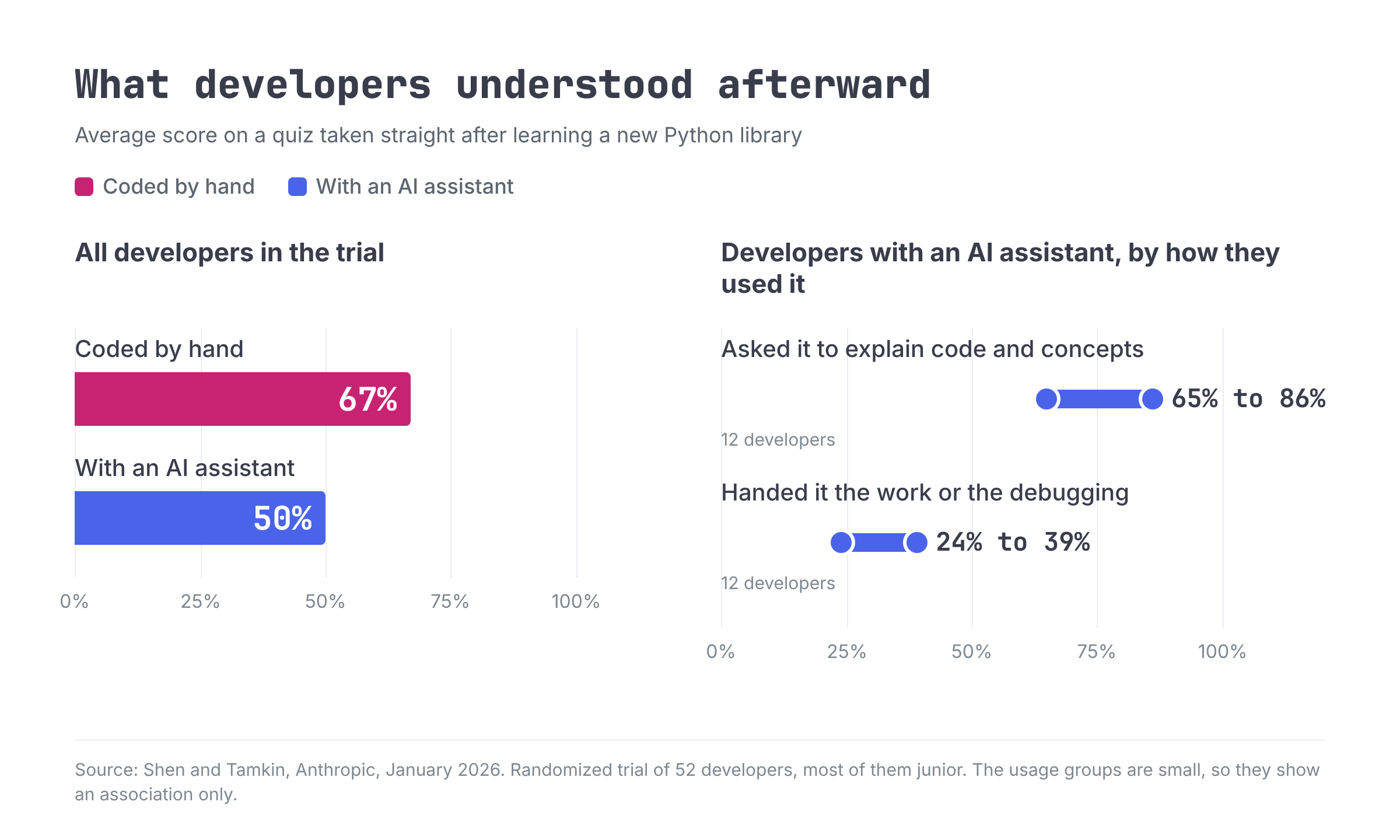
So the trial makes the case for both kinds of task. With AI off, you see whether a candidate understands the code. With AI on, you see how they use the assistant, and in the trial, people who used it to understand the code also understood more. The most advanced AI users already work both ways: in Microsoft’s 2026 survey, the group it calls Frontier Professionals were more likely than others to do some work without AI on purpose to keep their skills sharp, 43% against 30%.
My view is simple. If the job uses AI, test with it on. If you need to see a core skill without AI’s help, such as reasoning through a data model or reading code someone else wrote, turn it off for that task. Many roles need both, and the same candidate can do both in one assessment. In Codility you can allow or turn off AI for each task in Screen and Skills Intelligence, and for each interview in Interview. When AI is on, every interaction is saved, so the hiring team sees exactly how it was used.
Why will each hiring decision carry more weight in 2027?
Companies are hiring fewer people into early-career roles, and hiring managers trust less of what they see in a remote interview.
Start with hiring volume. In a Gartner survey of 110 heads of HR, 22% said at least one business leader in their organization had stopped hiring for entry-level roles because of AI automation. Stanford’s Digital Economy Lab studied ADP payroll data through June 2026. In the jobs most exposed to AI, employment of people aged 22 to 25 is about 19% lower than it would be if it had grown like employment of people the same age in jobs less exposed to AI. The authors stress that the data cannot show how much of that gap AI caused. The bar for the roles that remain has moved up too: PwC found that entry-level roles most exposed to AI are 7 times more likely to require skills traditionally expected of senior people.
Then trust. Checkr, which sells background and identity checks, ran a survey of 3,000 US hiring managers in September 2026. 40% said they had interviewed a candidate who turned out to be using a fake identity, up from 31% in 2025. 60% said AI has made virtual interviews harder to trust, up from 51%. Gartner’s advice to heads of HR for 2026 is to pair new AI tools with steps where people meet candidates or watch them work, such as in-person interviews and assessments built on real work.
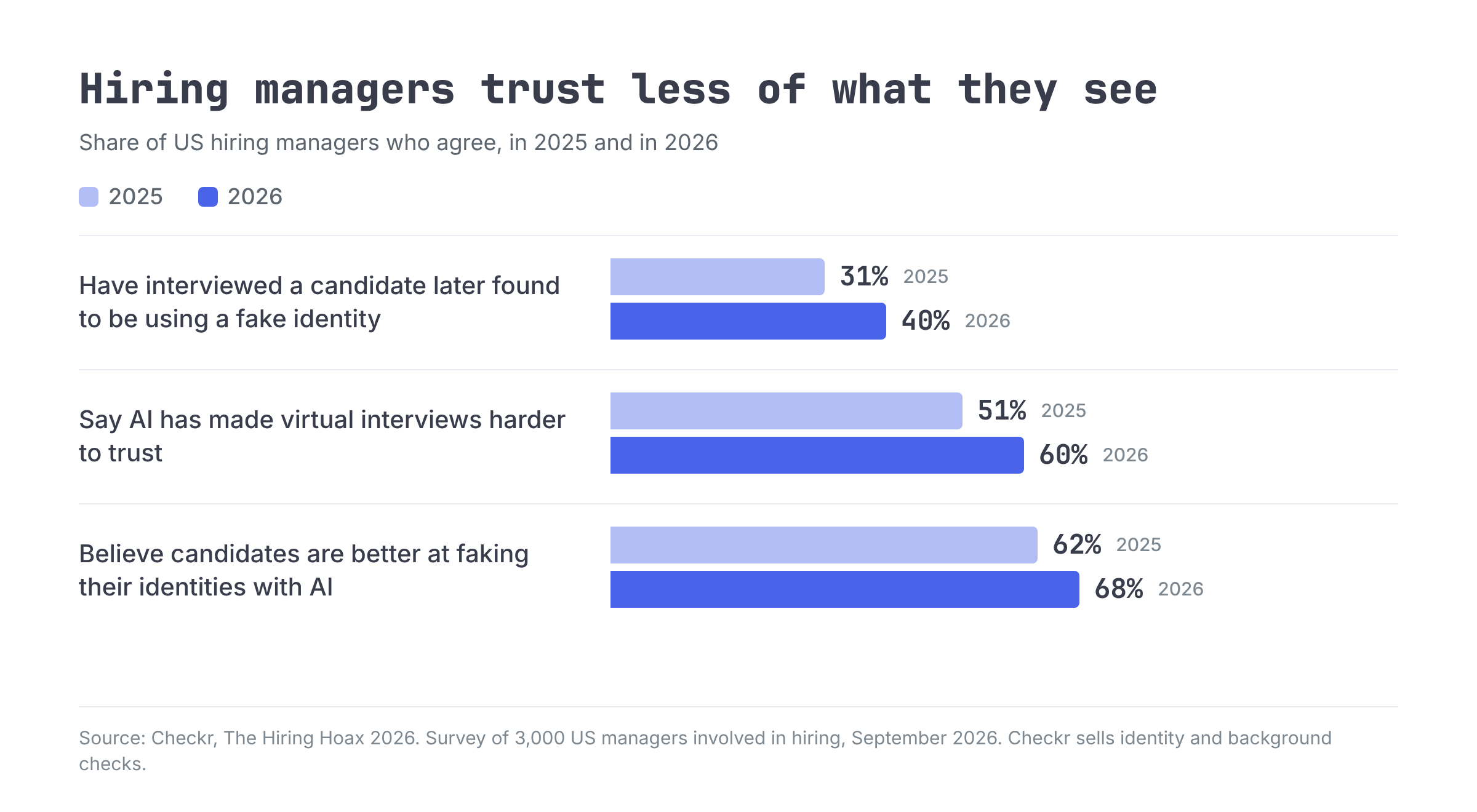
With fewer hires, each one matters more. A decision that rests on a resume claim and a single conversation is also harder to defend when someone questions it.
Our integrity signals are designed to show the hiring team what happened during an assessment, with evidence they can review. Identity verification matches the candidate to a photo ID. The Codility desktop app is designed to surface tools running invisibly over the candidate’s screen, and pattern detection flags code retyped from a second screen. Similarity checks compare each submission with others. These signals feed a risk level set by fixed rules, and a person reviews the evidence before acting on it. No AI model scores a candidate. Fixed rules score the work, and your team makes the call. Candidates tend to see the process as fair: in our candidate survey from October 2025 to April 2026, 90% of 46,204 respondents said they had a fair chance to show their abilities.
Is AI skill only an engineering question?
No. Every function now needs people who can work with AI, and many leaders say the skills are not there yet. BCG’s 2026 AI at Work survey of close to 12,000 employees, managers and leaders found that 72% say AI has changed the skills expected of them, and only 36% feel they have had adequate training. In a Gartner survey of 197 executives published in May 2026, just 20% believe their workforce is truly ready for AI.
A training dashboard shows who finished the course. The question leaders will be asked in 2027 is who can do the work. One talent leader put it to us plainly: “Don’t test whether my people know the AI tools. Test whether they can actually solve a problem with them.”
AI for Business brings our approach to business roles. It runs inside Screen and Interview for hiring into sales, marketing, finance, operations and customer roles, and inside Skills Intelligence for the people you already employ. Tasks take 5 to 60 minutes. Fixed rules score the work the person hands in against answers experts defined in advance, and every prompt is saved. It runs on the same assessment engine, scoring, reporting and security that companies have used for engineering hiring since 2009. For engineering teams, Skills Intelligence helps you see the same picture across the organization: who can already build with AI, and who to train next.
Who is accountable when AI is part of hiring?
A person, and 2027 is the year companies will have to write down who. One of Gartner’s top priorities for heads of HR in 2027 is that “human accountability is essential no matter what work AI takes on.” Its July 2026 survey of 297 heads of HR found that only 24% of leadership teams agree on who should be accountable for AI agents. Gartner’s conclusion is that people have to keep the final say over AI.
Regulation adds a date. The EU AI Act puts AI systems used in hiring, such as software that sorts resumes, in its high-risk category, the one with the strictest rules. The EU amended the Act in 2026 with a package called the AI Omnibus, in force since July 27, 2026. Under it, those strict rules apply to hiring from December 2, 2027. The Act has had 2 rules in force since February 2, 2025: employers must take steps to help staff understand the AI they use, and they may not use AI to read people’s emotions at work, except for medical or safety reasons.
Your legal team decides how the Act applies to your process, and our EU AI Act checklist for hiring sets out what to have in place. Before December 2027, I would get 2 answers in writing from every vendor in your hiring process: what AI touches in scoring, and what record is kept of each decision.
Our answer to the first is short. No AI model scores a candidate. Fixed rules score the work, and your team makes the call. Our answer to the second is the record itself. Every score sits beside the work, the full AI interaction and the integrity signals. Our 92-page Technical Manual, structured to APA Standards, sets out how our assessments are built and validated, and gives your legal team documentation they can use for an EU AI Act review.
How should you prepare your hiring process for 2027?
Start with the roles you will hire for most in the first half of 2027, and work through these steps for each one.
- Write down how the job uses AI today: which tools, for which tasks, and where a mistake would cost the most.
- Build the assessment from that work, with a realistic task, the files behind it and the same tools.
- Decide for each task whether AI is on or off, and keep a record of every interaction when it is on.
- Score against rules written before anyone takes the task, and make sure a person makes the final decision.
- Check the candidate’s identity and the integrity signals before you decide, and keep the evidence.
- Ask every vendor in your process what AI touches in scoring, and get the answer in writing before December 2, 2027.
I expect the companies that hire well in 2027 to be the ones that can show their work: what they tested, how they scored it and who made the call. If you want to start with a single role, talk to us and we’ll build the first assessment with you.
About the author
I lead product marketing at Codility, where I own how the platform is positioned across Screen, Interview and Skills Intelligence, and I work alongside the Assessment Science team behind the Engineering Skills Model. I came to hiring from the other side of the AI question: before Codility I led product marketing for AI data and model evaluation at Toloka, serving frontier AI labs and large technology companies. I have also built marketing teams from nothing 3 times, so the hiring problems I write about are ones I have had myself. I am based in Rome, Italy.
Frequently asked questions
The research points to 6 shifts. Employers test for AI skills: Gartner predicts that by 2027, 75% of hiring processes will include certifications and testing for workplace AI proficiency. Checking AI’s work becomes the key skill. Teams test candidates with AI on and with it off. Each hire matters more, because companies hire fewer entry-level people and meet more candidates using fake identities. Every department needs AI skills. And a person owns every hiring decision.