
Codility vs LeetCode for hiring engineers_
LeetCode is the practice library almost every engineering candidate already knows. Codility is built for organizations hiring engineers who work with AI, with work simulations, deterministic scoring and a reviewable record behind the decision.
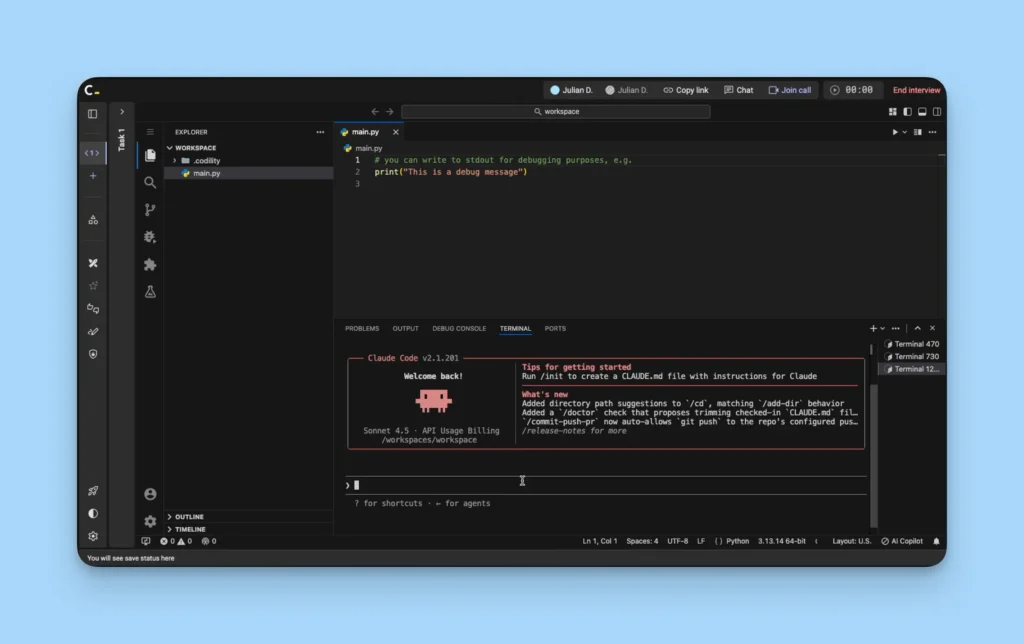

Codility is built for organizations hiring engineers who work with AI. Tasks are work simulations drawn from the work a role actually does, scoring is fully deterministic with a documented methodology, and cut scores are monitored for adverse impact. It also gives you one evaluation model to run across teams and regions. Codility does not suit a team that wants a free self-serve tool.

LeetCode holds 4,059 practice problems, a fast and precise judge refined over a decade, and a community nothing else in the category matches. Candidates arrive already knowing the environment, and practicing on it is free.
How Codility and LeetCode compare
| Capability | Codility | LeetCode |
|---|---|---|
| Scoring | Fully deterministic scoring with full explainability. Criteria are fixed and weighted before release, and every score traces back to them | Results report pass or fail against hidden test cases, runtime and memory, and a percentile against other LeetCode submissions. No scoring methodology, validation or adverse impact data is published, so there is nothing to put in front of a candidate who challenges the result |
| Task library | More than 1,300 tasks, each validated by Assessment Scientists, calibrated for difficulty and monitored for adverse impact, plus virtually unlimited custom tasks created with AI through Codility’s dedicated task creation MCP, drawing on your own codebase if you choose | 4,059 public practice problems as of September 2026, roughly 90 percent algorithms and data structures, with 323 SQL problems. Problem statements are publicly readable and community solutions are widely republished |
| AI in the assessment | Claude Code is available inside Screen, Interview and Skills Intelligence, preconfigured in the VS Code terminal. You enable or disable the AI Assistant per assessment. With it enabled, every interaction is captured as reviewable AI activity. With it disabled, the integrity signals are designed to surface outside help | Ask Leet is a coding assistant built for candidates practicing on the platform. No AI capability inside an employer assessment is documented |
| AI skills beyond engineering | AI for Business assesses how candidates and employees in business roles work with AI | Not documented. Every library category is a technical runtime |
| Integrity | ID verification, behavioral monitoring, code evolution replay, secure desktop mode designed to detect invisible AI overlays, copy-paste controls, Similarity Check, typing pattern detection and cheating apps detection. Signals resolve into one deterministic Integrity Risk level that shows which signals contributed, route to a human reviewer and never auto-reject a candidate | No proctoring, plagiarism detection or identity verification is documented. LeetCode Premium sells candidates the questions named companies ask, compiled from candidate surveys, so a candidate can practice your interview before they sit it |
| Live interviews | Codility Interview runs in VS Code with a terminal, sidecar services, a whiteboard, a full transcript and one shared session, and stands on its own if screening is not the gap | LeetCode Interview runs a shared editor with video and voice, a whiteboard for custom challenges and live-rendered frontend frameworks, in the environment candidates already practice in |
| Integrations | 80+ integrations across applicant tracking systems (ATS), human resources information systems (HRIS) and scheduling tools, with support for single sign-on (SSO) and SAML | Lever documents a LeetCode Enterprise integration. No integration list, API documentation or enterprise single sign-on is published, and LeetCode is absent from Greenhouse’s assessment partner directory |
| Data hosting | US and EU hosting options available | A consumer privacy policy states data may transfer to the United States. No hosting regions, SOC 2, ISO 27001 or data processing agreement is published, so a security review has nothing to read |
Competitor capabilities change. Details checked against public sources in September 2026, and confirm current specifics with each vendor.
Which is the right fit?
Choose Codility if
- You need fully deterministic, explainable scoring with a documented methodology behind the decision
- You want candidates working with Claude Code, the AI posture set per assessment, and every interaction captured as reviewable AI activity for a human reviewer
- You need one evaluation model to run across teams, regions and hiring volumes
- You need integrity controls that resolve to reviewable evidence and one deterministic Integrity Risk level: ID verification, behavioral monitoring, code evolution replay, secure desktop mode and copy-paste controls
- You want experts in the loop: Assessment Scientists on task design and cut scores, solution engineers on rollout
Choose LeetCode if
- You want a free, self-serve tool your engineers and your candidates already know
- You are measuring algorithmic problem solving specifically, where the library is the deepest available anywhere
- You run occasional live interviews and want a shared editor with video, voice and a whiteboard with no setup
What reviewers say on G2
Codility reviews
903
Average rating
4.6 / 5
Summer 2026
Leader
LeetCode is listed on G2 under Technical Skills Development, alongside learning platforms, so no head-to-head compare report exists against the Technical Skills Screening category.




Platform plus people
Enterprise customers work with a named team, not a login page: Assessment Scientists and occupational psychologists on task design, cut scores and adverse impact, solution engineers on the platform, and advisory work on assessment strategy and AI best practices.
Ask each vendor who your team will actually work with after the sale.
Claude Code
Claude Code is available inside Codility Screen, Interview and Skills Intelligence. It is preconfigured in the VS Code terminal and requires no separate Claude account or API key.
Frequently asked questions
Are Codility tasks LeetCode-style problems?
No. Codility runs work simulations: tasks drawn from the work a role actually does, in a real environment with a terminal, sidecar services such as a database or a queue, and real packages. A candidate reads existing code, fixes a defect, builds a feature or extends a service, and the work is scored against criteria fixed and weighted before the task was released.
A LeetCode problem is self-contained, has one correct output and is solved against hidden unit tests. That format measures algorithmic problem solving well, and LeetCode’s library is the deepest anywhere for it. It is a different measurement from the one most hiring teams tell us they want.
Can we use LeetCode to screen candidates?
How does Codility know whether a candidate tried to cheat?
How do we move from LeetCode to Codility?
Compare Codility with other platforms
Codility vs HackerRank
Question library size against deterministic scoring, integrity evidence and one evaluation model across teams.
Codility vs CodeSignal
A vendor-led hiring process against keeping the decision, and the ability to explain it, in your hands.
Codility vs CoderPad
A lightweight pad against interviews that run in a real environment and leave a reviewable record.
Codility vs HackerEarth
A large question library and a hackathon community against a documented assessment methodology.
Codility vs Coderbyte
Breadth across many question types against depth in the engineering evaluation.
Codility vs TestGorilla
One library covering every role against an evaluation built for the engineers you are hiring.
Codility vs BlueOptima
Analytics over code your engineers already wrote against a fresh, validated measure of what they can do.