

Article AI and Hiring
The case against AI interviews

In short
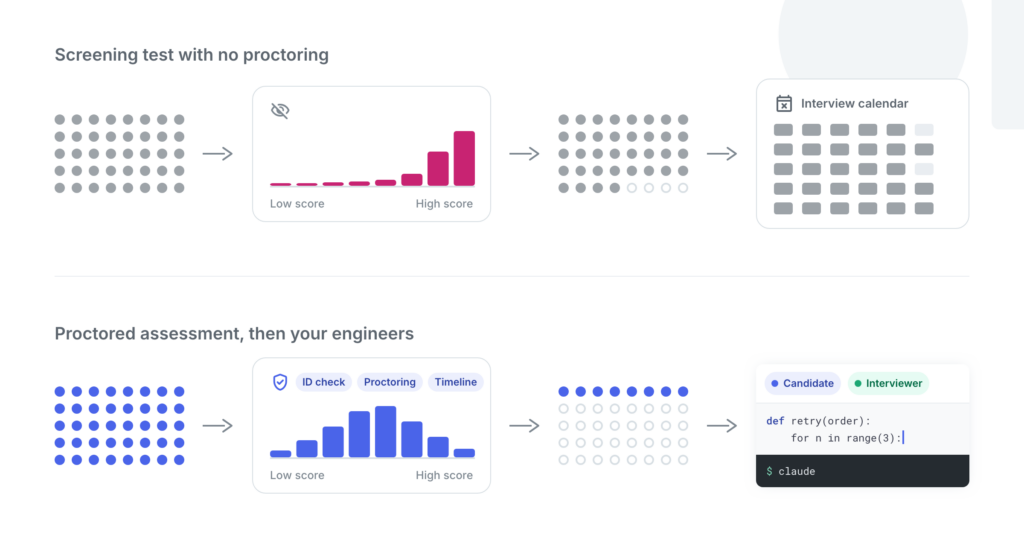
An AI interview is a job interview where software asks the questions and scores the answers, with no interviewer from the hiring team. Candidates are walking away from them. In experiments with real US tech job ads, far fewer applicants finished when no person ran the interview, and the most experienced applicants were the first to quit. Companies still need a screening step, because their engineers cannot interview everyone. That step has to be proctored, because AI can now pass unproctored tests. The better setup is a proctored technical assessment built on real-world problems, then a live interview with the hiring team’s own engineers.
- 38% of US candidates in a 2026 Greenhouse survey said they had pulled out of a hiring process because it included an AI interview.
- In a 2024 experiment with real US tech job ads, 68% of applicants joined a live video interview with a person, and 40% finished a recorded interview with no interviewer. Among applicants with 14 or more years of experience, it was 78% against 36%.
- Only 25% of applicants invited to a required 30 to 40 minute AI interview for a junior frontend engineer role finished it, and the more experience they had, the more likely they were to quit.
- An unproctored screen is easy to beat with AI. In a 2025 study, an OpenAI reasoning model scored at the 95th percentile on a pre-employment ability test, up from below the 20th for GPT-4.
- The alternative is a proctored technical assessment built on real-world problems and scored the same way for every candidate, then a live interview with your own engineers, with coding agents such as Claude Code in the room.
- The same holds for business roles: a real piece of work done with an AI assistant, scored the same way for everyone, then a live interview with the hiring manager.
Why are candidates walking away from AI interviews?
“Companies are very, very bad at remembering they’re being evaluated, too.” A career coach said that to CNBC in September 2026, and candidates have been saying it online for longer. The most-discussed comment in the biggest online thread on AI interviews came from a candidate who knew from the start they were talking to software. They talked to it for about 45 minutes, never heard from the company again, and swore off AI interviews for good. That thread, on Hacker News in August 2025, ran to 882 comments, most of them just as negative. When The Verge covered its reporter’s own AI interview in March 2026, the top reply on Hacker News made the career coach’s point from the candidate’s side: a company that will not show up for your interview is showing you how it will treat you once you work there.
Candidates do not love companies like mine either. I said as much to colleagues in the conversation that started this piece: at best, assessment vendors are tolerated. Engineers spent a decade cramming algorithm questions to pass screening tests that had little to do with the job, and companies like ours earned much of that resentment.
I also understand why companies buy AI interviews. A hiring manager in that same March discussion laid out the numbers. One job post brought in more than 300 applicants in a day, and every round of interviews takes about 4 hours of engineers’ time. An AI interview promises a structured conversation with every applicant, at any hour, without pulling an engineer out of their week. In October 2026, one assessment vendor publicly apologized to developers for years of algorithm drills, and in the same campaign launched its own AI interviewer.
AI interviews answer a real problem, the time engineers spend interviewing. Candidates reject the answer.
How many applicants finish an AI or recorded interview?
The clearest measure of candidate experience is who finishes. The best evidence comes from experiments with real job ads, where researchers randomly assigned applicants to different kinds of interview and counted who kept going.
In a study published by the University of Exeter in March 2026, economists from Monash University and partner universities advertised 3 tech jobs on major US job boards: programmer, web designer and content creator. They split 3,296 applicants into 3 groups. One group had no interview step. One had a live video interview with a person. One had to record answers with no interviewer present. With no interview, 85% of applicants continued. 68% joined the live interview. 40% finished the recorded one.
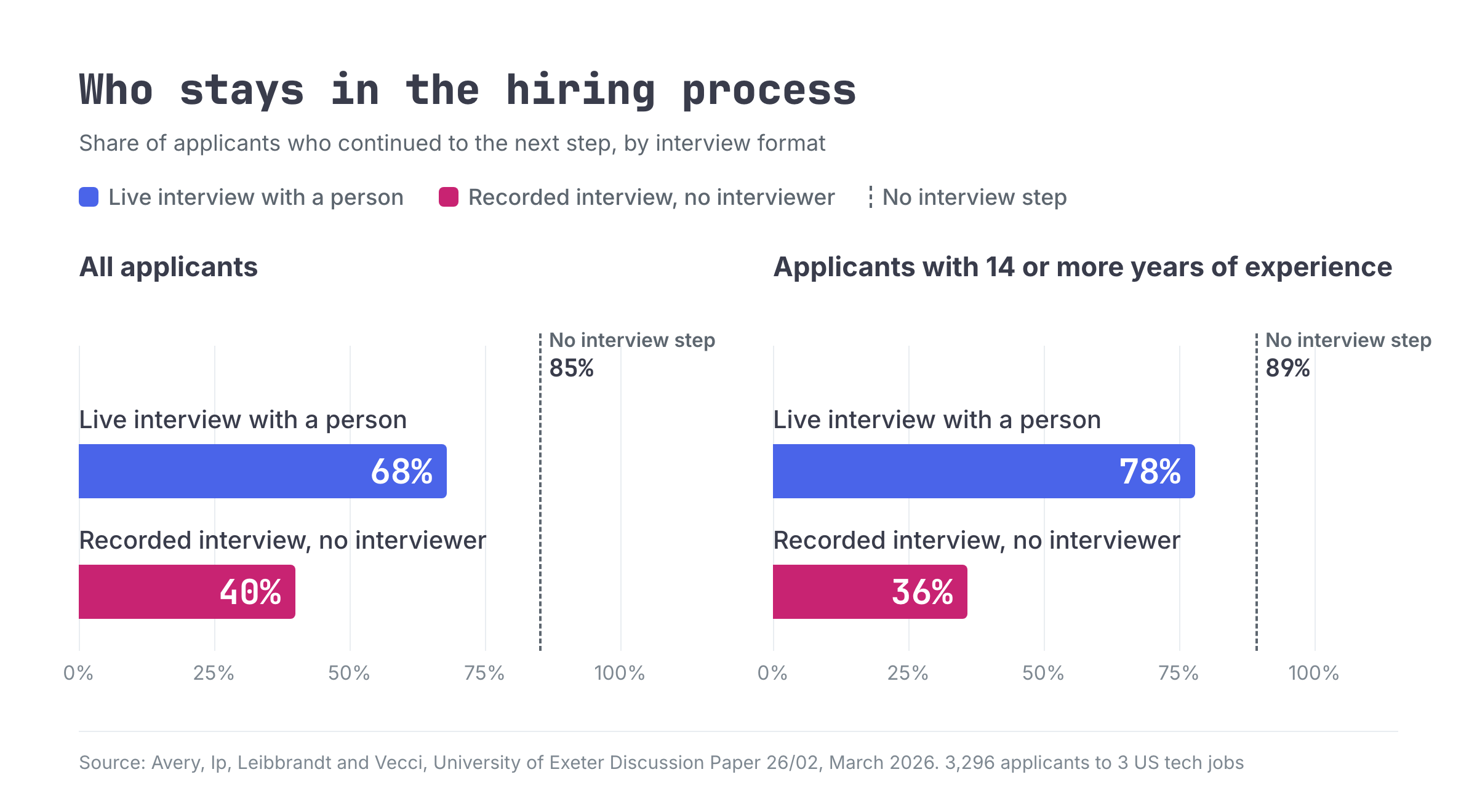
The gap was widest among the applicants employers most want. Of those with 14 or more years of experience, 78% joined the live interview and 36% finished the recorded one. Telling applicants that an AI would score their recording barely mattered. It moved completion by 3 points, too small to count. So the AI itself was not what put people off. The missing person was.
A second experiment tested an AI interview directly. Researchers advertised a junior frontend engineer role, received 34,493 applications, and required some of the applicants to complete a 30 to 40 minute AI interview. Only 25% of those invited finished it, and the more experience an applicant had, the more likely they were to quit. Two of the authors work with the company whose AI ran the interview, so this figure comes from the vendor’s own side. In both experiments, women dropped out slightly more often than men.
Surveys say the same. In Greenhouse’s 2026 survey of 2,950 candidates in 5 countries, 38% of those in the US said they had pulled out of a hiring process because it included an AI interview. Gartner found in 2025 that 26% of candidates trust AI to judge them fairly.
You hear the same from individual candidates. CNBC reported on a 65-year-old IT program director, with more than 600 applications behind him, who hung up when an AI interviewer kept repeating its questions and talking over him. On Blind, an anonymous forum for tech employees, an engineer at a large tech company turned down a startup’s first-round AI voice interview and asked to speak to a person.
The strongest study in favor of AI interviews is worth taking seriously. In a 2025 experiment hiring call-center staff in the Philippines, 78% of applicants chose an AI voice interviewer when given the choice. Applicants interviewed by the AI got about 12% more job offers, and human recruiters still made every hiring decision. If you hire large numbers of people into entry-level service jobs, read that study closely. Experienced engineers are a different case. They have other options, and the tech experiments above show them taking those options.
Isn’t an AI better at scoring interviews than a tired engineer?
Sometimes, and the research says so. Before Codility I worked in AI model evaluation, so I take these results seriously. In the Exeter study, the AI’s scores predicted how applicants were doing in their careers a year later at least twice as well as the human recruiters’ scores did. The AI also scored the same way at any time of day, while the recruiters’ scores changed depending on when they did them. A 2026 study in the Journal of Applied Psychology found that several of the newest AI models, used together, can rate interview answers about as reliably as one trained human rater. Its authors still advise caution before using them for hiring decisions.
The problem is what an AI interview judges: how a candidate talks. In a 2025 study presented at a leading AI ethics conference, AI models gave lower scores to interview transcripts from Indian candidates than to those from UK candidates, even with names removed. The gap came down to sentence structure and vocabulary. In a 2025 University of Melbourne study, one AI interview vendor’s own figures showed a transcription error rate under 10% for US English speakers and as high as 22% for non-native speakers with accents. The AI then scores the candidate on that flawed transcript.
CNBC also reported on a candidate with nystagmus, an eye condition that causes involuntary movement. Her AI interviewer kept telling her to look straight ahead, until she could not get through her answers.
For engineering roles, how someone talks about their work tells you little anyway. A candidate who explains how they would fix a bug has shown they can explain it. Watching them fix it shows whether they can, and a person in the room can ask why they made each choice.
What happens when candidates use AI to cheat?
AI interviews have a second problem, on the candidate’s side. In Gartner’s 2025 survey of 3,000 candidates, 6% admitted to interview fraud, either posing as someone else or having someone else interview for them. Gartner predicts that by 2028, 1 in 4 candidate profiles worldwide will be fake.
Candidates have noticed. In the largest forum threads on AI interviews, a common reply is that if a company sends a bot to interview them, they will send a bot to answer. One AI interview vendor reported that 38.5% of the 19,368 interviews on its own platform between July 2025 and January 2026 triggered its cheating flags. The vendor sells that detection, so treat the number with care. It still matters that a company selling AI interviews published it.
Human interviewers miss hidden AI too. In a 2024 experiment by interviewing.io, a mock interview platform, candidates secretly using ChatGPT passed 73% of interviews built on well-known questions from LeetCode, a popular practice site, and no interviewer caught them. When the questions were written fresh, they passed only 25%. Watching a face and listening to answers is a weak way to tell whether a candidate is getting help, whoever does the watching.
Can’t an online assessment do the screening on its own?
You still need a screening step. Without one, every applicant lands on your engineers’ calendars, which is the problem AI interviews promise to solve.
A screening test left on its own, with no proctoring, now mostly measures the candidate’s AI. In a 2025 study in the International Journal of Selection and Assessment, Louis Hickman of Virginia Tech gave a commercial pre-employment ability test to AI models. GPT-4 scored below the 20th percentile of thousands of human test takers. OpenAI’s o1, a reasoning model, scored at the 95th. Hickman’s conclusion was that few assessments will stay safe for long, and the first fix on his list is more proctoring. The rest of his list describes how a good assessment platform already works: record how candidates work, test them on tasks drawn from the job, and design some tests to allow AI and watch how it is used.
An unproctored screen fails you twice. Candidates who paste the task into an AI score near the top, your shortlist fills with people who cannot do the job, and your engineers lose the time the screen was meant to save.
What should replace AI interviews?
Start from what each side asks for. Candidates want to meet a person, and they want their time respected. Hiring teams want their engineers to spend interview time on the right people, and a decision they can explain.
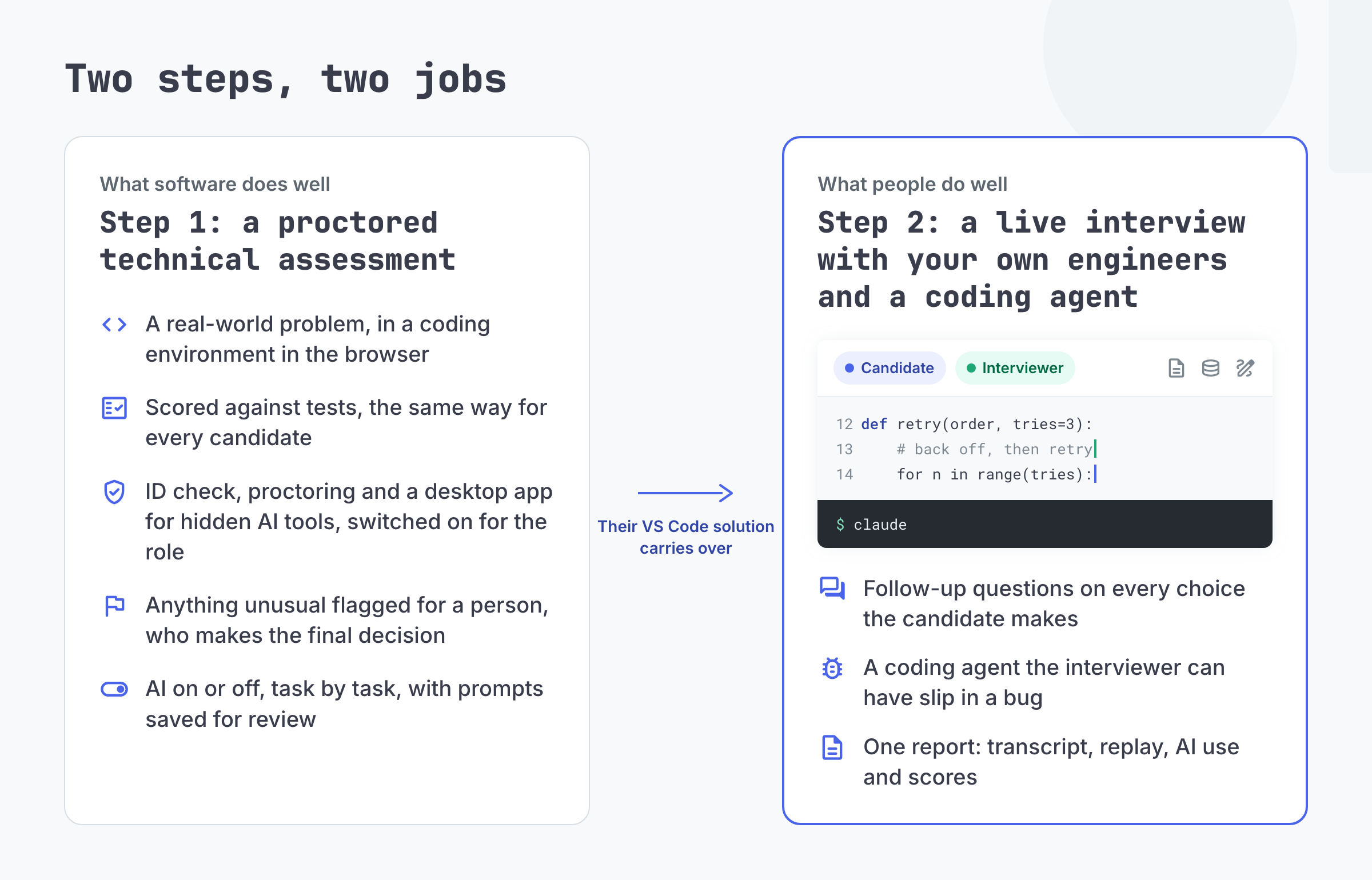
That splits the job in 2. Software is good at giving thousands of applicants the same real task, under proctoring, and scoring it the same way every time. People are good at asking follow-up questions, judging how someone works with others and persuading a strong engineer to join. An AI interview hands that second job to software.
Step 1: a proctored technical assessment built on real-world problems
Give every applicant a short task that looks like the job, such as fixing a bug or adding a feature in an existing codebase. It runs in the browser in a real coding environment and is scored automatically against tests, so the same code always gets the same score.
Then switch on the controls the role needs. This is where the platform matters. Codility runs a full set of integrity controls in one assessment:
- An ID check confirms who is taking the test.
- Webcam and screen proctoring capture snapshots or a full recording of the session.
- A lightweight desktop app, for macOS and Windows, is designed to surface AI tools that hide from screen sharing.
- Pasting, tab switching and typing patterns are logged on a timeline of the session.
- A similarity check compares the code with other candidates’ work and with known solutions.
Those checks flag anything unusual and give each candidate one risk level, from None to High, worked out by fixed rules with no AI involved. A person on your team reviews what was flagged and makes the final decision. Our guide to preventing cheating in coding assessments covers each check.
Match the controls to the role. For a senior role where AI stays off, that might mean the ID check, proctoring and the desktop app. For a role where engineers work with AI every day, switch AI on for the task: the AI Copilot and Claude Code run inside the coding environment, and you see the prompts the candidate wrote and how they used the AI’s answers, next to their code. Our guide to AI in technical assessment covers how to decide.
This step is also what protects your engineers’ time. They only interview the shortlist the assessment produces.
Candidates do not love automated tests, and some say so. In the Hacker News thread on Amazon’s AI interviews, one engineer said Amazon’s automated coding tests alone had put them off applying. Candidates do accept a test that respects them: short, close to the job and fair. In Codility’s post-assessment survey from October 2025 to April 2026, 90% of 46,204 respondents agreed the assessment gave them a fair chance to show their abilities, and 87% rated their experience good or excellent. Agreement that the content was fair stayed above 83% in every demographic group surveyed.
Step 2: a live interview with your own engineers and a coding agent
Then put the shortlist in front of your own engineers, with the same task and the same scorecard for every interviewer. Asking every candidate the same things is what makes an interview predict job performance. A major 2022 review of decades of hiring research found that structured interviews, where every candidate gets the same questions and the same scorecard, predicted job performance better than any other hiring method it measured. That research is about interviews run by people.
Run the interview in a real coding environment, with coding agents in it. In Codility Interview, candidate and interviewer share a VS Code editor in the browser, the same editor many engineers use every day. It has a terminal, a database where the task needs one, and a whiteboard for design questions. Anthropic’s Claude Code runs in the terminal. The AI Copilot runs in the editor, with Agent, Chat and Plan modes and models from Anthropic, OpenAI and Google. Both run in Screen and Skills Intelligence too. In October 2026 both moved to new models within days of their launch: Claude Sonnet 5.5, which Anthropic released on September 28, and GPT-6.1 Sol, which OpenAI released on September 29, were live in Codility on October 2. You decide for each interview whether to switch them on.
This is the part of hiring that needs a person. Your engineer watches the first instruction the candidate gives the coding agent, asks them to explain its changes before they accept them, then changes a requirement halfway through and sees how they adjust. With AI Instructions, the interviewer can also have the agent slip a bug or a poor coding practice into its work and see whether the candidate catches it. The candidate does not see the instructions. For VS Code tasks, if you create the interview from the candidate’s Screen report, their code from the assessment comes with it, so the conversation can start from work they already did. Afterward, everyone on the hiring panel sees the transcript, a replay of the session, the AI use and the interviewer’s scores in one report from our technical interview platform.
Why should your own engineers conduct the interview?
The interview matters to candidate experience because it works both ways. While you assess the candidate, the candidate assesses you, and the interviewer is often the first engineer they meet. When Amazon announced AI interviews in April 2026, an engineer on Hacker News put it plainly: interviewing is a two-way street, and candidates learn about their future teammates from the person interviewing them. That is the career coach’s point from the start of this piece, seen from the candidate’s chair.
The companies furthest ahead on AI make the same choice. Published guides to how OpenAI, Anthropic, Meta and Shopify hire engineers describe interviews run by people. Where they allow AI, a person runs that round and grades how the candidate directs the AI, checks its work and explains the result.
Then there is the question of who answers for the decision. Talent leaders on our calls raise AI-generated scores without being asked, and the worry I hear most is legal. The EU AI Act treats AI that evaluates job candidates as high-risk. Since February 2025 it has also banned AI that reads a candidate’s emotions from their face or voice. Codility uses no AI or machine learning in scoring or in hiring decisions. Scores and risk levels come from fixed rules, and a person on the hiring team makes the decision.
So are AI interviews ever the right choice?
For engineering hiring, I would not use one. The assessment should be a real-world problem, scored the same way for every candidate. The interview should be with people, with coding agents like Claude Code available where everyone can see how they are used.
For business roles, I would not use one either, for the same reasons. The Exeter study included a content creator role alongside the programming jobs, and the Greenhouse survey covered job seekers in every kind of role. In business roles, AI is now part of the work itself, so the question is whether someone can get real work done with it. An AI interview asks them to talk about that. With AI for Business in Codility Screen, the candidate does it: they produce a real piece of work with an AI assistant, and the work is scored the same way for every candidate. The hiring manager then runs a live interview in Codility Interview.
There is one narrow case for AI interviews. When you hire large numbers of people into entry-level hourly roles, scheduling is the main problem, and a person still makes the decision, the call-center study suggests an AI phone screen can work. That study is about getting people through a phone screen faster. It tells you little about choosing an engineer you will trust with your production code, or an analyst you will trust with your numbers. Those decisions should involve the people the new hire will work with.
About the author
I lead product marketing at Codility, where I own how the platform is positioned across Screen, Interview and Skills Intelligence, and I work alongside the Assessment Science team behind the Engineering Skills Model. I came to hiring from the other side of the AI question: before Codility I led product marketing for AI data and model evaluation at Toloka, serving frontier AI labs and large technology companies. I have also built marketing teams from nothing 3 times, so the hiring problems I write about are ones I have had myself. I am based in Rome.
Frequently asked questions
What is an AI interview?
An AI interview is a job interview conducted by software with no human interviewer present, often sold as an AI interviewer. It asks questions by voice, video or text, often adapts follow-up questions to the candidate’s answers, and produces a score or summary for the hiring team. Some products also evaluate code the candidate writes during the session.