

Article AI and Hiring
How do you prevent cheating in coding assessments?

In short
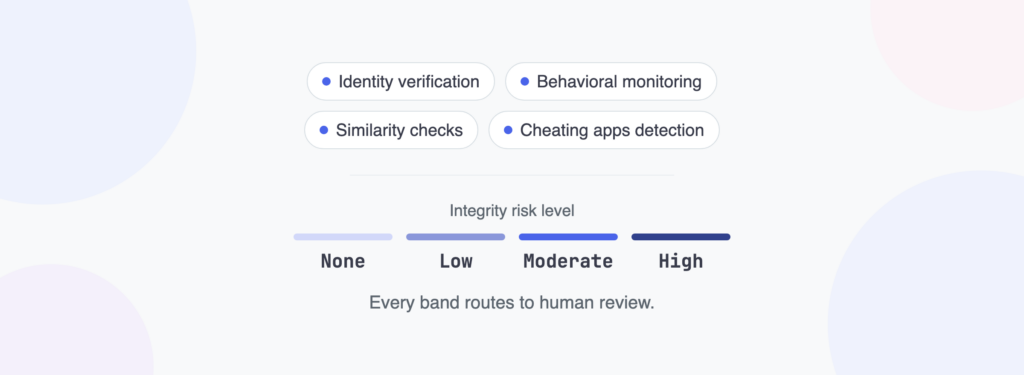
Preventing cheating starts with assessment design, then adds layered controls: identity verification, behavioral monitoring, and similarity checks. Codility turns these signals into a deterministic integrity risk level backed by reviewable evidence, and Cheating apps detection addresses stealth AI tools separately, so a human makes the final call on a defensible record.
- Cheating in technical hiring is real, and teams hiring at volume describe the same patterns: fraudulent candidates, outsourced interviews, and a proctoring burden that does not scale.
- Detection on its own becomes an arms race; design, layered signals, and human review are the sustainable posture.
- Codility’s integrity risk level is deterministic, with four bands from None to High, built with occupational psychologists.
- Stealth AI cheating apps are addressed by Cheating apps detection in Screen and Interview.
- Every flag is evidence for a human decision, and no candidate is rejected automatically.
How big is the cheating problem in technical hiring?
Cheating in technical hiring is a real problem, and it shows up most clearly in what teams hiring at volume describe.
Talent leaders tell us about fraudulent candidates, about interviews quietly outsourced to a stronger engineer, and about a proctoring burden that becomes unsustainable as a program scales.
None of this is hypothetical for teams hiring at volume, where even a small share of compromised assessments erodes trust in the whole funnel.
Naming the problem plainly is how you size the response correctly. The goal is a hiring signal you can defend, and that calls for more than a single tool bolted on at the end.
How do candidates actually cheat now?
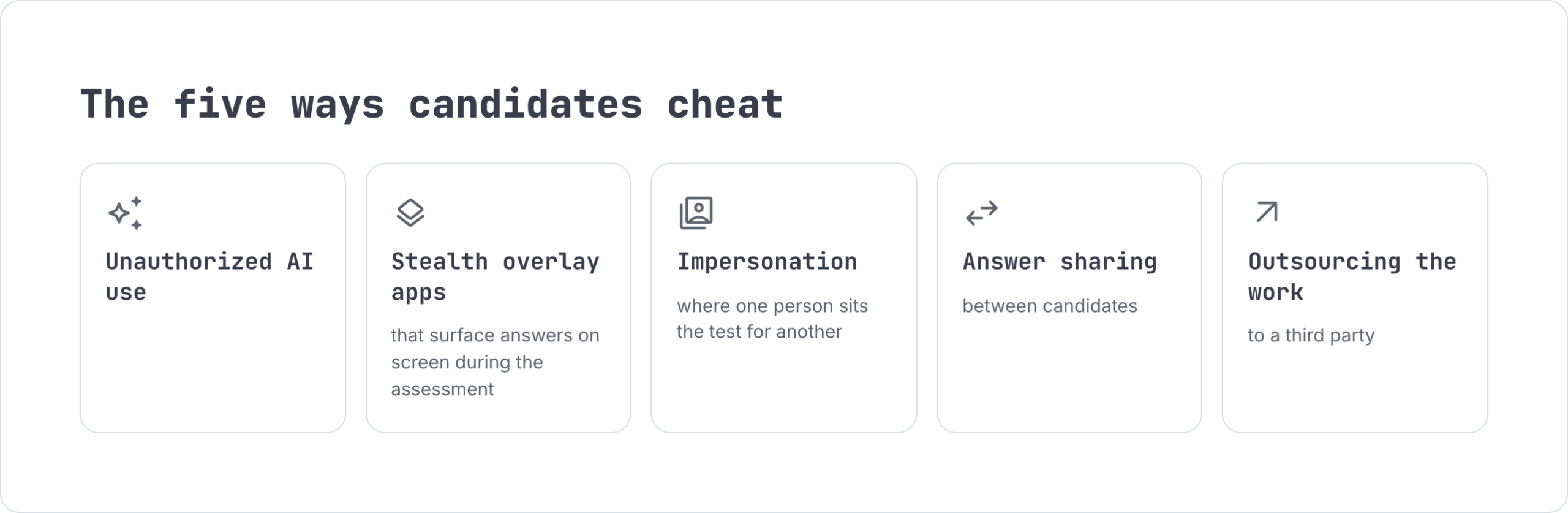
Candidates cheat on coding assessments in a handful of recognizable ways. The common categories are unauthorized AI use, stealth overlay apps that surface answers on screen during the assessment, impersonation where one person sits the test for another, answer sharing between candidates, and outsourcing the work to a third party.
Naming the categories matters more than naming the tools because specific apps appear and disappear every quarter, while the behaviors they enable stay stable.
A durable integrity posture is designed around those stable behaviors, so it holds up even as individual tools come and go.
Why is pure detection the wrong foundation?
Pure detection is a weak foundation for assessment integrity because it commits you to an arms race. Every new stealth tool calls for a new detector, and a detector tuned to be highly sensitive will also flag honest candidates.
A wrongly flagged candidate carries a real cost: a good hire lost, and a decision that is hard to defend if it is ever challenged.
Design-first choices compound over time, while detection-first choices decay as tools evolve. The more an assessment rewards genuine problem-solving, the less weight a single detector has to carry.
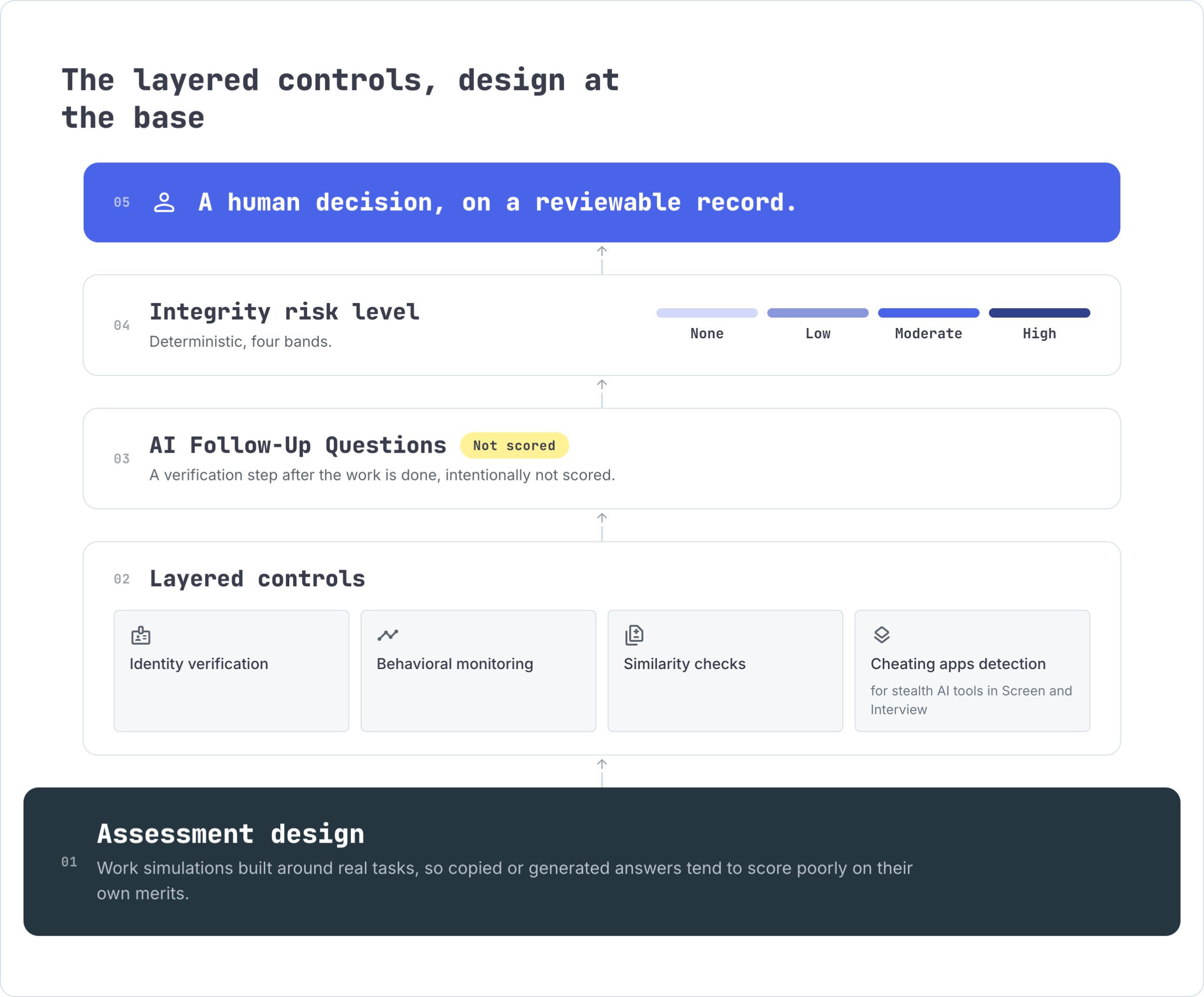
Design reduces the attack surface before a single signal is collected. Work simulations built around real tasks mean copied or generated answers tend to score poorly on their own merits, and an in-environment AI Assistant helps make permitted AI visible rather than hidden. We treat detecting AI authorship as the wrong place to start, and our framework for how AI fits into technical assessment sets out the wider position.
What layered controls does Codility run?
Codility runs several integrity controls that work together rather than depending on a single check.
Identity verification confirms that the person taking the assessment is who they claim to be, and behavioral monitoring surfaces signals such as code retypes, browser absence, tab switching, and paste volume. Similarity checks compare a submission against known sources.
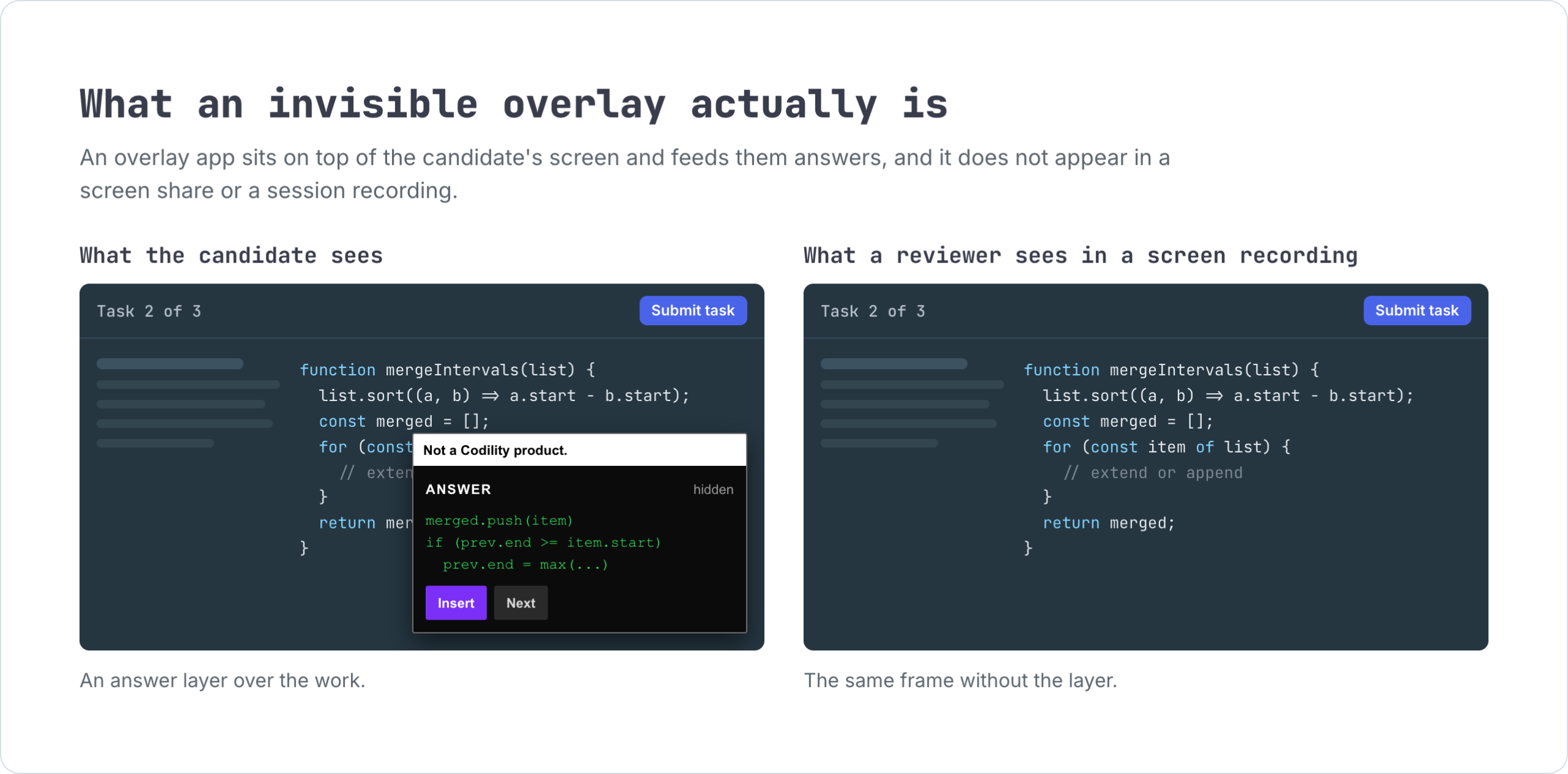
For the newer category of stealth AI cheating apps, Cheating apps detection addresses those tools inside Screen and Interview, meaning the hidden apps that try to feed answers to a candidate mid-assessment.
AI Follow-Up Questions add a verification step after the work is done. They are intentionally not scored, so they add a check without adding bias to the result. Together, these controls give a reviewer more context than a single check could on its own.
How does the integrity risk level work?
The integrity risk level is a deterministic rating with four bands: None, Low, Moderate, and High. It is built with occupational psychologists, and it combines behavioral and identity signals using fixed rules rather than machine learning, so the same inputs always produce the same band.
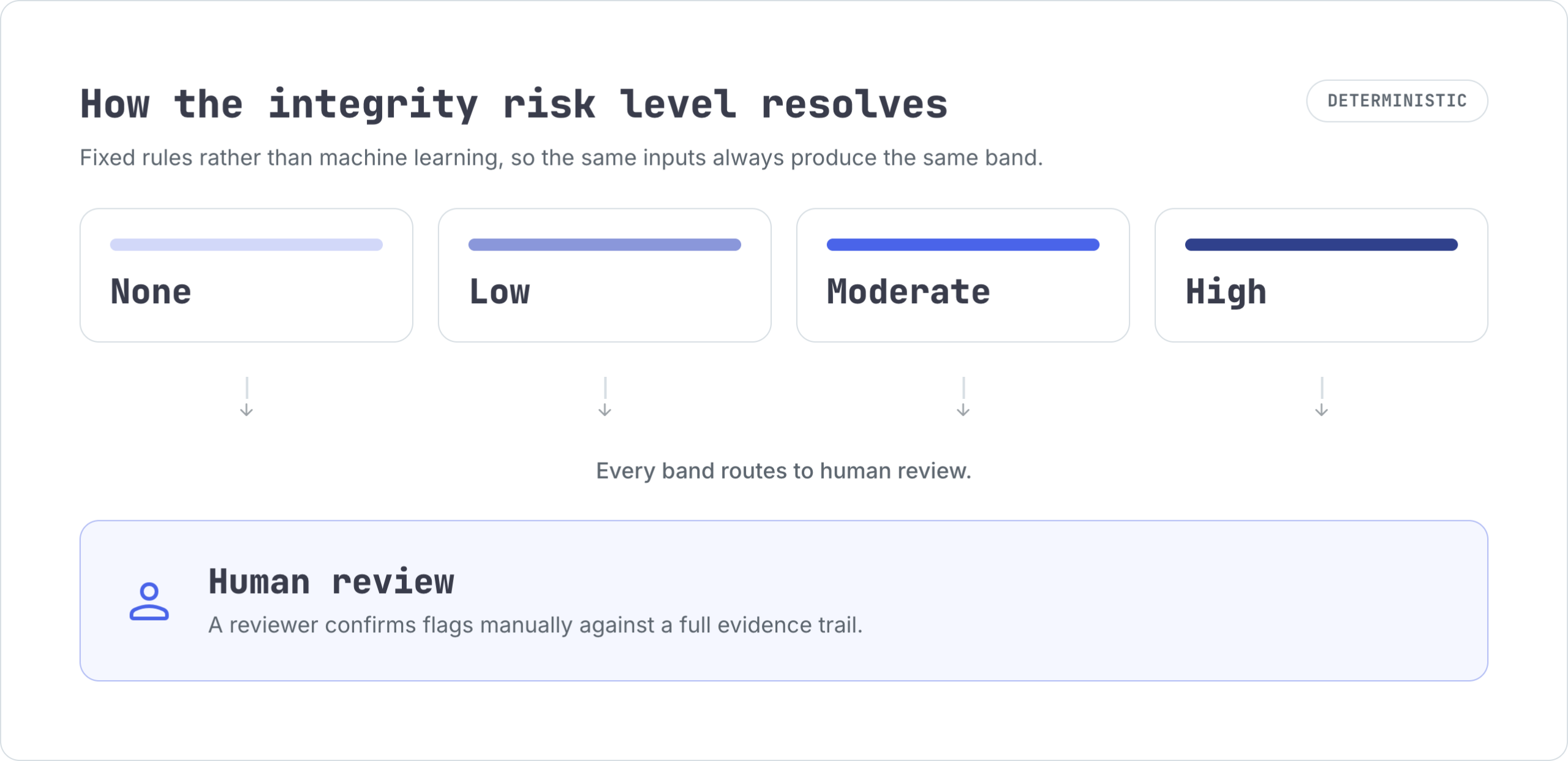
Each band is a signal for a human to weigh. A reviewer confirms flags manually against a full evidence trail, and the rating informs a person’s decision.
Determinism is also what makes the result explainable. A fixed-rule rating can be walked through step by step in an audit or an EU AI Act review, which a machine-learning score cannot offer in the same way. That traceability is the heart of compliance and defensibility across the whole process, and our EU AI Act hiring checklist works through what it requires obligation by obligation.
What should a talent team do this quarter?
The practical first move this quarter is to switch on the integrity controls already available in your plan. Much of the capability described here ships available but off by default, and teams sometimes conclude there is no answer to AI-assisted submissions when the answer is sitting unused in their account.
Turning those controls on costs nothing extra. From there, decide your AI posture for each assessment. In a coding assessment, the AI Assistant is enabled or disabled per assessment, with every candidate interaction captured as reviewable AI activity.
Then review each flag alongside its evidence before a decision is made. That review habit is what keeps a hiring decision defensible. Documenting who reviewed a flag and why turns an integrity decision into a record you can stand behind later.
Frequently asked questions
How do candidates cheat on coding assessments?
Candidates cheat on coding assessments in a few recognizable ways: unauthorized AI use, stealth overlay apps that surface answers during the test, impersonation where someone else takes the assessment, answer sharing between candidates, and outsourcing the work to a third party. Specific tools change constantly, while the underlying behaviors stay stable, which is why a durable integrity posture is designed around behaviors rather than named tools.