

Article Assessment Research
Traditional validation was built for a slower world. Careers got shorter and hiring got faster

In short
On June 9, 2026, the Department of Justice’s Office of Legal Counsel (OLC) concluded that the way the Equal Employment Opportunity Commission (EEOC) has long applied disparate-impact liability under Title VII is unconstitutional, and reinterpreted the standard considerably more narrowly. For hiring teams, the operative question shifts from proving everything up front toward showing that an assessment is plausibly tied to the work.
This article reflects the author’s opinion as an assessment practitioner and does not constitute legal advice.
- Validation is the evidence that an assessment measures something the job actually requires, and it is a large part of what separates a defensible hiring process from a biased one.
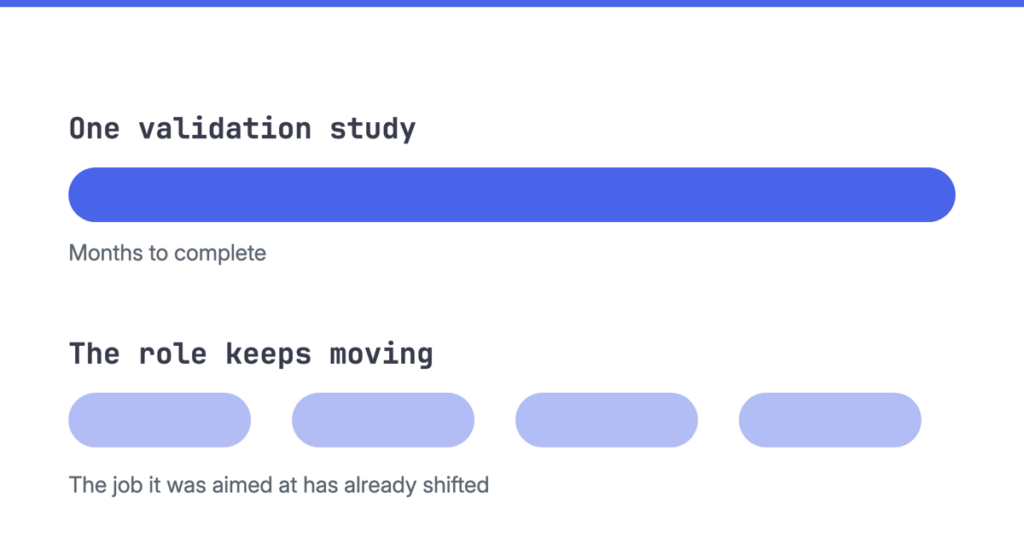
- The traditional playbook assumed slow-moving roles. A local validation study can run for months, and AI is changing job content faster than that.
- The OLC opinion sets a lower business-necessity bar, puts robust causation on plaintiffs, and requires them to identify an equally effective lower-impact alternative.
- This is an executive-branch opinion rather than settled law. Courts have not ruled, private and state claims remain, and it does not address the Age Discrimination in Employment Act (ADEA).
- The scientific obligation does not move because the legal one did. Job-relatedness and adverse impact are different questions, and this opinion eases only the first.
For the last year and a half I have been wrestling with a tension that a recent legal development has brought into sharper focus. Validation in hiring exists for good reason. It is the evidence that a test, an interview, or a screening question measures something that matters for the job rather than something incidental to it, and it is a large part of what separates a fair, defensible hiring process from a biased one. The burden of doing it robustly is real, and it has been getting harder.
AI is reshaping what counts as job-relevant more quickly than I have seen before, and roles themselves are changing at a pace where a thorough validation study is sometimes finished only to find that the job has already moved on. What concerns me is that, in my experience, the weight of all this occasionally pushes organizations to step back from assessment altogether, which is close to the opposite of what we would want. The point of validation was always better, fairer hiring decisions, and never a process so heavy that people abandon the practice.
On June 9, 2026, the OLC issued an opinion that speaks directly to this tension. To see why it matters, it helps to start with why validation has carried so much weight for so long.
Why has validation always mattered in hiring?
At its core, validation is the discipline that keeps companies from screening people out on criteria that look reasonable but do not actually relate to the work. A degree requirement for a job that does not need one. A brain-teaser that rewards a particular background more than the ability the role calls for. Done well, validation protects candidates from arbitrary barriers and protects employers from unscientific, unfair, and legally risky decisions.
The legal weight traces back to Title VII and the concept of disparate impact. The underlying idea is that even a facially neutral practice, applied identically to everyone, can be challenged if it screens out one protected group at a meaningfully higher rate and the employer cannot show it is job-related. Since Griggs v. Duke Power in 1971, and the framework Congress wrote into Title VII in 1991, formal validation studies have been one of the primary ways employers demonstrate that job-relatedness.
So validation is important, and that is not changing. The difficulty is the cost and speed of doing it the traditional way, in a labor market that no longer moves at the pace the framework assumed.
Why is the traditional validation model under strain?
I think it is the pace of validation that is really the heart of it. The playbook most organizations follow was designed for a slower, more stable labor market, one where a role was a reasonably fixed thing you could study at length. A local validation study can take months, and that made sense when the backend engineer you validated for in January was doing essentially the same job in December.
That stability has eroded, and a few forces seem to be pulling at it at once. Roles are changing more quickly than they used to, so the half-life of a job description keeps shrinking, and by the time a long study wraps, the target it was aimed at has often shifted. I think AI is a big part of that. What a competent engineer does day to day looks fairly different than it did even a year ago, and a framework built around slow-moving job content can struggle to keep up. Meanwhile, organizations still have to hire, and when the rigorous path to validation feels like it takes a quarter, the practical temptation is to fall back on resumes, pedigree, or intuition, which tend to be the less fair and less predictive signals that good assessment was meant to replace in the first place.
Taken together, these pressures produce the tension I opened with. A standard that exists to make hiring fairer can, when it becomes too slow and heavy, push organizations away from the very practice that makes hiring fairer. That is the gap this opinion speaks to.
What does the DOJ opinion actually say?
The opinion concluded that the way the EEOC has long applied disparate-impact liability under Title VII is unconstitutional, and it reinterprets the standard considerably more narrowly. It is fairly direct about it:
EEOC’s Title VII guidelines are unconstitutional because they contemplate liability based on disparate effects alone, without regard to an employer’s likely intent, and pressure employers to engage in race-based decisionmaking.
DOJ Office of Legal Counsel, June 9, 2026
In practical terms, it sets out three principles that, read together, rebalance the burden.
- Business necessity is a relatively low bar. An employer needs to show that a practice rationally serves a valid business purpose, and common selection tools, including aptitude and knowledge-based tests, are treated as presumptively job-related.
- Plaintiffs must establish robust causation. A statistical imbalance on its own is no longer sufficient, and a challenge has to isolate the specific practice that caused the disparity.
- Plaintiffs must identify an equally effective alternative. An employer’s justification cannot be set aside unless a genuinely equivalent, lower-impact practice was available without significant added cost or burden.
Read together, this is a meaningful shift away from the heavy, study-first posture and toward a more proportionate question: is this practice plausibly tied to the work? That tends to be a faster question to answer than a full traditional validation study.
Is this settled law?
No. Before reading too much into that shift, it is worth being precise about what the opinion is. An OLC opinion is binding on federal executive agencies, so the EEOC is expected to align its enforcement with it, and it is neither a statute nor a court ruling, and it does not on its own rescind any existing EEOC guideline. Courts will ultimately decide whether the reading holds, private plaintiffs and state agencies can still bring disparate-impact claims under existing law, and the opinion expressly does not address age discrimination under the Age Discrimination in Employment Act.
So I would be cautious about reading this as validation going away. It seems more accurate to say that the federal posture is moving in a more employer-friendly direction, and that the trajectory favors organizations whose assessments are tightly tied to the actual work.
There is a fair counter-view here, and I think it deserves to be taken seriously. A lower legal bar could, in the wrong hands, give cover to weaker or less fair practices that a stricter standard would have screened out. That is a real risk, and it is precisely why I would argue the scientific and ethical obligation does not move just because the legal one does. The pendulum that had swung toward employers proving everything up front appears to be swinging back, and it should not swing past the point of good measurement.
What does it change for adoption and speed?
With that caveat in mind, this is where it gets practical. One of the larger drags on adopting structured assessment has been the perceived weight of getting validation right before you can move at all, and as that burden eases, a couple of things seem likely to follow.
The first is that time-to-adoption should shrink. If the operative question becomes whether an assessment is plausibly job-related rather than whether a months-long formal study has been completed, teams can stand up fair hiring in a meaningfully shorter window.
The second is that speed and defensibility may stop feeling like a trade-off. For a long time, moving quickly and staying defensible felt like opposite ends of a seesaw. A lighter, job-relatedness-focused standard makes it more possible to keep pace with roles that change month to month while still standing on reasonably solid ground.
The quality bar holds. It simply sits closer to where the job actually is, and organizations can reach it with less friction.
What should you do in the meantime?
I would start with the unglamorous part, which is to keep complying with current EEOC guidance and applicable state and local law, since none of that has formally changed. It is worth taking the signal seriously, though, and this seems like a good moment to do two things.
First, make sure your assessments are tightly aligned to the real work, and document why each task matters for the role. That is the validation side of it.
Second, and separately, keep a steady, ongoing eye on how candidates perform across groups. Job-relatedness and adverse impact are different questions, and this opinion only eases the first.
How can validation get leaner without getting weaker?
The part I find interesting is that the requirement staying the same does not have to mean the methods stay the same, and this is where I see assessment scientists getting more creative.
For decades, proper validation has leaned heavily on subject-matter experts, which usually means pulling those experts off their day jobs for job-analysis workshops, focus groups, and several rounds of survey work. That is expensive, slow, and hard to schedule, and it is a large part of why validation can feel so burdensome. The burden there was logistical rather than scientific.
Assessment teams are finding leaner ways to reach the same defensible place. Well-calibrated AI personas can take on some of the early legwork, generating realistic job scenarios and surfacing edge cases before a busy expert is ever pulled into a room, so that expert judgment is reserved for where it matters most. In-platform validation feedback can shorten the loop, so you are observing how items behave as candidates take them and adjusting closer to real time rather than discovering an issue in a report months later. AI-assisted content generation can help produce and refine job-representative tasks at a pace that keeps up with roles that are themselves changing month to month.
None of this replaces scientific rigor or human judgment, and none of it changes what the law currently asks of us. It removes the parts of the process that were heavy for logistical reasons rather than scientific ones, leaving the standard of evidence intact while reducing the drag.
Where do high-fidelity work samples fit?
This is also where high-fidelity work samples tend to earn their place. When candidates are put in front of realistic work that maps directly to the job, you have something close to the textbook case of a defensible, business-necessity practice, which is exactly what a job-relatedness-focused standard rewards. When the work itself is the assessment, speed and defensibility stop pulling against each other quite so much.
The above reflects my own opinion and interpretation as an assessment practitioner, and it is not legal advice. The DOJ Office of Legal Counsel document referenced here is itself an opinion, binding on federal executive agencies but neither a statute nor a court ruling. For your specific situation, consult qualified employment counsel.
Sources: DOJ Office of Legal Counsel opinion, June 9, 2026; DOJ press release on the EEOC disparate-impact guidelines.
Frequently asked questions
What did the DOJ Office of Legal Counsel opinion say about disparate impact?
It concluded that the way the EEOC has long applied disparate-impact liability under Title VII is unconstitutional, because the guidelines contemplate liability based on disparate effects alone without regard to an employer’s likely intent. It then reinterpreted the standard more narrowly, setting a lower business-necessity bar and placing heavier causation and alternative-practice burdens on plaintiffs.